Sunday, July 30, 2006
Better Trading Blog has moved!
Yes, Better Trading Blog has moved to its own space Tradergav.com
I'll be keeping this blog alive and old postings will still available here.
New home and better tool to keep my journals.


Friday, July 28, 2006
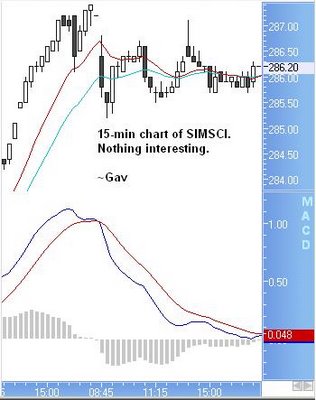
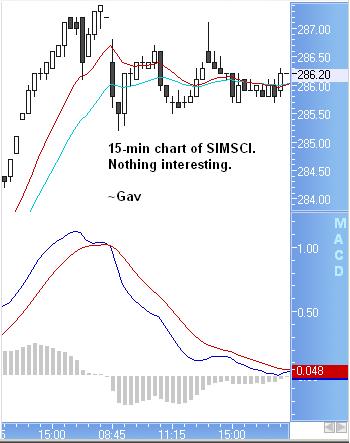
RE: Dummy day trading 28-Jul-2006:SIMSCI: No trade
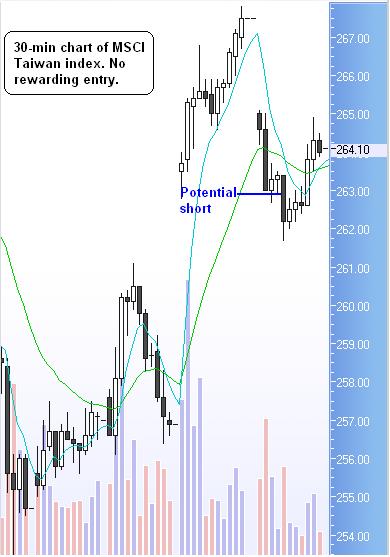
Look at the chart , you know what I am going to say. No trade.
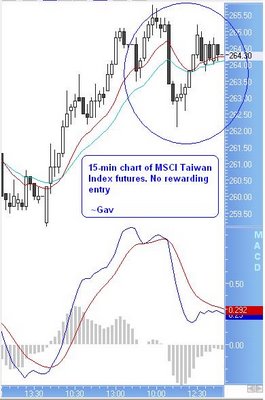
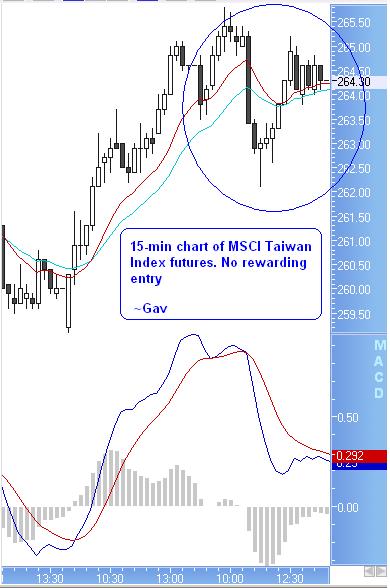
RE:Dummy day trading : 28-Jul-2006: No trade
TIMSCI was hovering around moving averages and did not provide rewarding entry. No trade was taken.
Dummy day trading 28-Jul-2006
Good morning!
Bulls made a cheat yesterday on Dow futures. It headed up in the opening, and pressed by bears. I did not make any trade yesterday.
A quick one. SIMSCI is moving above intrady moving average. Though I see some weakness in the uptrend, it is not strong enough for me to go Short.
TIMSCI is still moving in intraday uptrend as well. I am not considering any SHORT for this morning.
By the way, I am looking at August contract for both index futures.
Thursday, July 27, 2006
Re: Dummy day trading 27-Jul-2006
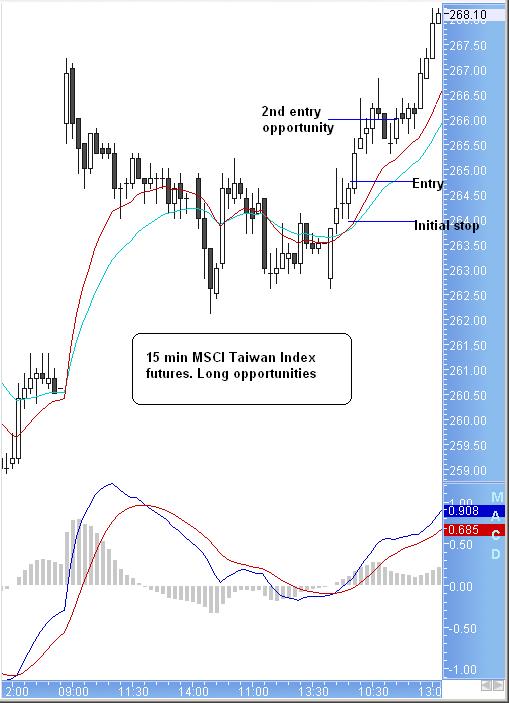
Alrite, I am being a loser today. In fact, I did not pay much attention to the market. Instead, I was day dreaming, and doing some stupid work out of trading. Long opportunities appeared. Simple and profitable entries, and yet, no trade was taken.
Continue doing this, I will be hungry to death someday.
Anyway, here is the 15-min chart of MSCI Taiwan index futures.

Dummy day trading 27-Jul-2006
It was an choppy day for DJ. No trade was done yesterday.
SIMSCI and TIMSCI look interesting. Both opened low and starts moving up. Though the regional market sentiment is rather flat at the moment.
I will only look at Long side if I were to establish any position for this morning.
Wednesday, July 26, 2006
Dummy day trading 26-Jul-2006 II: Mini Dow
'Crude futures rise after steeper-than-forecast decline in U.S. gasoline inventories'
'Oil prices rise after gasoline inventory shortfall.'
Are these news related to day trading? Well, it might be. At least , I am seeing intraday Dow futures starts to turn down and in fact broken uptrend line. Though I have yet to have complete setup for the day, I tend to look at Short side.
Dummy day trading 26-Jul-2006
I am looking forward to a 'do-nothing' day again for SG futures market. I am not interested in trading in this condition i.e moderate U.S gain, flat opening in Nikkei and low volume in local futures market. It is difficult to find high-R trade in the market with these conditions.
Tuesday, July 25, 2006
RE: Dummy day trading 25-Jul-2006
No trade was done for SiMSCi and TimSCi today. It was indeed an boring day, though SiMSCi did have a spike at the last 15 min before market closed.
Dow futures was down at the opening, and subsequently spike up. Bulls did not hold the strength, intraday downtrend continues. I am watching for possible short entry for Mini Dow.
Dummy day trading 25-Jul-2006
Good morning! I am a silly person. I like to think too much and make things complicated. My objective today is to keep thing simple.
Alrite, 3-digit gain of DJ pushed gaps up around Asian markets as expected. I am looking at the tone of regional markets. Pretty positive, Nikkei gains near +300 points and HangSeng is fatter by around +200 points. SIMSCI looks interesting today, while I see TIMSCI having some wild swings. Ok, I am looking for Long opportunity of SIMSCI, though I am still waiting for entry point to completely form.
By the way, I rejected few comments by some readers (named annonymous) due to the language (some chinese dialects) used in the comments. Thanks for reading and do give me some comments, of course, in simple english. :-)
Monday, July 24, 2006
Change
I have made some major changes to my system after studying and reading books and blogs recently. The change was not caused by recent losses, after all, I am still in pretty nice profitable situation. :-) The reason behind this change is the seek of simplicity. Yes, I was in fact confused by my own system, and there is really a urgency to keep things simple.
The change is done mostly on entry part of the system. I am basically a trend following person and I will still stick with percent risk model for money management part. Instead of looking at shorter timeframe for day trading, I intend to lengthen the time frame to 30-min chart. Most of my entry rules are inspired by Maoxian. I am basically looking at reversal up/down bar or insider bar for entry opportunity.
Nothing much in this posting. Hope the simplicity works.
TIMSCI 24-Jul-2006: Short Trade closed
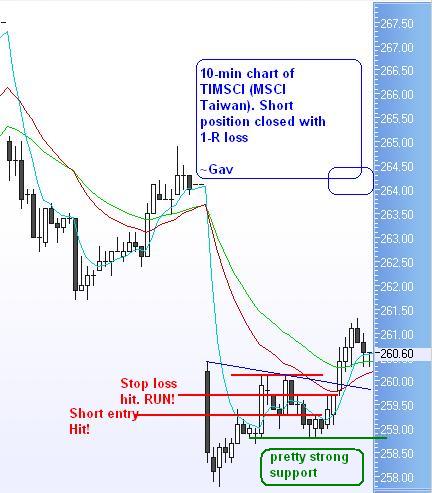 Short position of MSCI Taiwan index futures (TIMSCI) was established at 259.1. Initial stop loss 259.6 was triggered with 1-R loss.
"The wrong way to play it would be to attempt to “pick a bottom,” or fade the market; blindly enter short without waiting for a good spot; getting short without setting a stop, etc. The list of errors goes on and on, but people mainly make those three big mistakes.
Traders who know themselves, who have common sense, who are disciplined, and who have the ability to keep it simple will do just fine. Remember that many people in the market are either uneducated or uninformed. And most of the few who are educated and informed waste their time building “scenarios” and end up defeating themselves by trying to outsmart the market."
- Maoxian
Short position of MSCI Taiwan index futures (TIMSCI) was established at 259.1. Initial stop loss 259.6 was triggered with 1-R loss.
"The wrong way to play it would be to attempt to “pick a bottom,” or fade the market; blindly enter short without waiting for a good spot; getting short without setting a stop, etc. The list of errors goes on and on, but people mainly make those three big mistakes.
Traders who know themselves, who have common sense, who are disciplined, and who have the ability to keep it simple will do just fine. Remember that many people in the market are either uneducated or uninformed. And most of the few who are educated and informed waste their time building “scenarios” and end up defeating themselves by trying to outsmart the market."
- Maoxian
Day trading watch list: 24-Jul-2006
First hour trading shows a pretty clear picture for SG futures market. Here is the summary. At this point of time, I would only looking at Short opportunity.
SIMSCI only serves as a reference for the time being. I am not trading SIMSCI for the time being until I see improvement of volume and volatility.
| Intraday Trend | MSCI Taiwan Index Futures | MSCI Singapore Index Futures |
| Longer term | Down | Down |
| Medium term | Down | Down |
| Short term | Down | Down |
| Recent High | 261.1 | 278.8 |
| Recent Low | 256.4 | 276.8 |
| Trading direction | Short | Short |
Saturday, July 22, 2006
Mini Dow & Gold futures: Short opportunities.
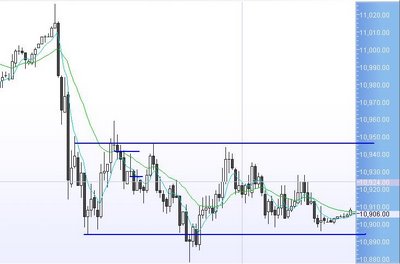
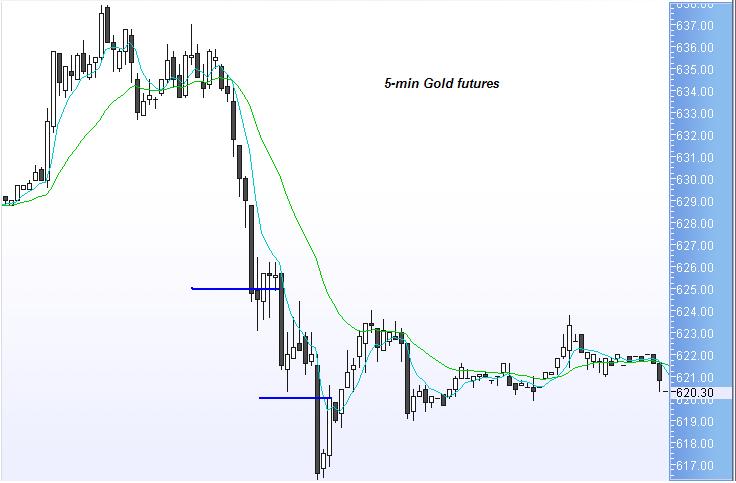
Mini dow was having a negative opening, and subsequently moving laterally. There was opportunity to established short position, however, with tiny profit. The risk of being stopped out was high.
 Gold reversed its initial movement after positive opening. Intraday trend turned down. Shorting opportunity apeared.
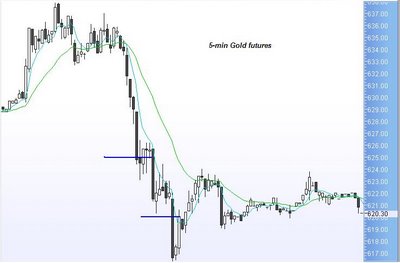
 Gold reversed its initial movement after positive opening. Intraday trend turned down. Shorting opportunity apeared.
Friday, July 21, 2006
Day trading II : 21-Jul-2006
Looks like we have some action in the futures market today. Here is the summary of current intraday trend during market open.
| Intraday trend | Mini Dow | Gold Futures |
| Intermediate term | Down | Up |
| Short term | Down | Up |
| Recent High | 11026 | 644.5 |
| Recent Low | 10826 | 621.2 |
Chop! 21-Jul-2006
Well, just as expected in the morning, we had a choppy , boring trading day in SG futures market. No trade was done.
Looking at volume of SIMSCI, I can fully understand why major oversea broking house like Interactive Broker does not bother to offer customers to trade. With just around 2000 contracts traded in a trading day. I guess, there is still long way to go to promote SIMSCI futures trading. I do not incline to relate this to market condition, it is just a matter of industry interest over this product.
Alrite, result reviewed. I got my first negative week. Making two losses in the the first two days of the week, and subsequently caught up by some personal works or did not see rewarding trading opportunity.

Day trading 21-Jul-2006
I will have to attend a meeting, no trading in the morning. Anyway, here is the view of this morning's market.
It looks like we are going to have a choppy day.
| Intraday trend | MSCI Taiwan Index Futures | MSCI Singapore Index Futures |
| Long term | Lateral | Lateral |
| Intermediate term | Lateral | Lateral |
| Short term | Lateral | Down |
| Recent High | 267.8 | 284.4 |
| Recent Low | 262.8 | 276.8 |
Thursday, July 20, 2006
No trade 20-Jul-2006
No trade was taken today, given the big gap up this morning, there was no riskwarding opportunity to enter SG futures market. Apparently, today might be a good day to do some puntings in SG stocks market. That's not my game.
My trading performance seems to be stalled. I gotta do something to get out of the current situation.
Day trading 20-Jul-2006
We have 3-digit gain , over +200 points in DJ last nite. It is likely to have some bullish hangover in Asian markets. SIMSCI volume is building up in the first half an hour, though it is still not impressive. Chart wise, I would prefer SIMSCI over TIMSCI for day trading today. I will be looking at Long only for this morning.
Here is the summary
| MSCI Taiwan Index Futures | MSCI Singapore Index Futures | |
| Longer term | Down | Lateral |
| Medium term | Up | Up |
| Short term | Up | Up |
| Recent High | 265.9 | 287.1 |
| Recent Low | N.A | N.A |
Wednesday, July 19, 2006
Lecture notes series: Percent Risk Model
I developed a habit of writing down whatever I learnt, this helps me to 'burn' the information into my mind. I did this during my school time as well. I decided to jot down what I have read from books so far in Lecture Note series. As mentioned in my previous posting, I am following Percent Risk Model for my position sizing. Of course, this is not the only model available, it is just the approach I applied in my business. I have amended the approach to suit my style. Basically, I will define initial stop level base on chart. It can be support/resistance level, straight trend line, Count back line or swing high/low.
Definition:
RISK - the point at which I will get out of the position in order to preserve my capital. It is x percent of my trading equity, for example, I will risk not more than 2% of trading equity in any trade.
Percent Risk Model - Controlling my position size as a function of the risk.
For example, with account size of $50,000, 2% of $50,000 is $1000. That means in any trade, I shall not risk more than $1000 with this account size.If I got a Long signal for SIMSCI at 289 and I have figured out from chart, proper stop loss level is at 287.5. On one contract basis, this trade requires $300 risk. With maximum risk amount $1000 available to me, I will be able to buy ($1000/$300=3.33) 3 contracts in this trade.
I quote a portion of Dr. Van Tharp's explaination from his book
'Just how much risk should you accept per position with risk position sizing? Your overall risk using risk position sizing depends upon the size of the stops you've set to preserve your capital and the expectancy of the system you are trading.'
Here goes on the explaination :
'if you are trading other people's money, you probably should risk less than 1 percent per position. If you are trading your own money, your risk depends upon your own comfort level. Anything under 3 percent is probably fine, if you are risking over 3 percent, you are a "gun-slinger" and had better understand the risk you are taking for the reward you seek.'
He explained the relationshiop with system expectancy as well:
'if you have high expectancies in your system (i.e your reliability is above 50% and your reward to risk ratio is 3 or better), then you can probably risk a higher percentage of your equity fairly safely'.
The percent risk model is the first model that gives trader a legitimate way to make sure that a 1-R risk means the same for each item he is trading. The advantage of this model is, it allows both large and small accounts to grow steadily. It equalizes performance in the portfolio by the actual risk. On the other hand, the disadvantage will have you to reject some trades because they are too risk.
Subscribe to:
Posts (Atom)